On this page▾
Why Mexico Calling Costs Add Up Fast
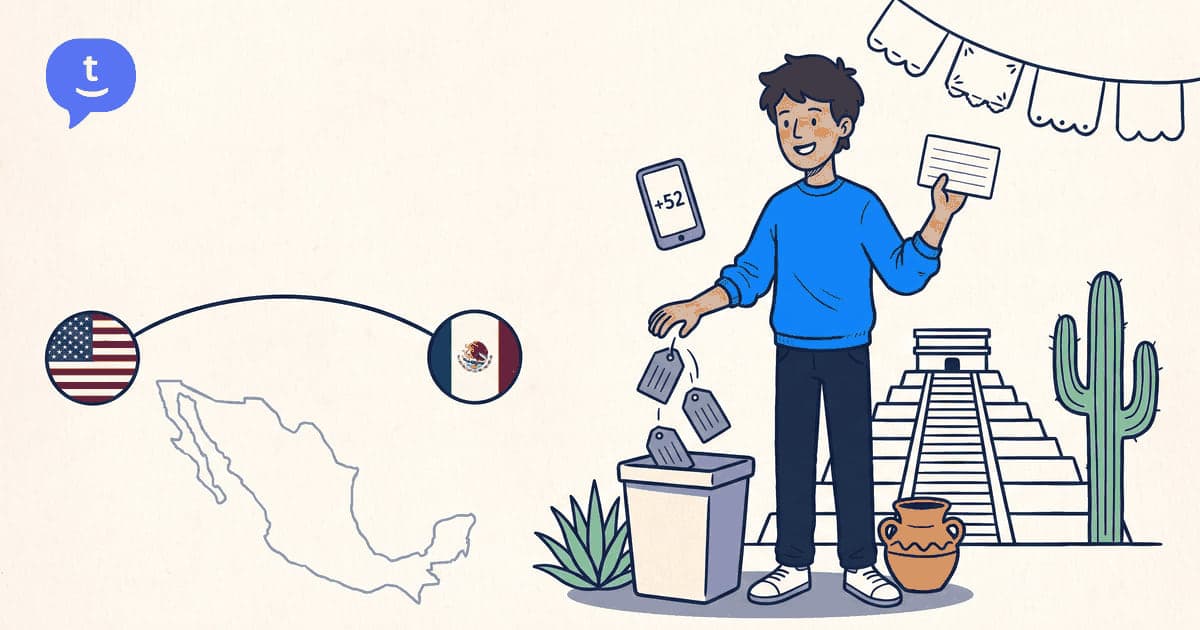
Mexico is the most-called international destination from the United States. That is not surprising — over 37 million people of Mexican origin live in the US, and the business ties between the two countries run deep. Cross-border calls happen millions of times per day.
You would expect that kind of volume to mean cheap rates. For carriers, it does not always. Without an international plan, a US carrier can charge a dollar or more a minute to Mexico — check your plan. AT&T, Verizon and T-Mobile each handle Mexico differently: some plans include it, others charge an add-on fee plus per-minute rates, and coverage and rate details vary by plan tier.
The real problem is frequency. Most people calling Mexico are not making one call a month. They are calling multiple times per week — parents, siblings, business partners, suppliers. A daily 10-minute call to a mobile in Guadalajara adds up to hundreds of minutes a month, and at a no-plan carrier rate that becomes a serious bill. Even plans that include Mexico can have limits, and calls to Mexican mobiles on cheaper plans may still incur charges.
The carrier markup on Mexico calls is especially aggressive on mobile numbers. The wholesale cost to deliver a call to a Mexican mobile is a few cents a minute or less, and landline termination is cheaper still.
VoIP services route calls over the internet and connect to the Mexican phone network directly, cutting out the US carrier middleman entirely. The savings are immediate and substantial.
5 Ways to Call Mexico, Ranked by Cost
Here are the five main methods for calling Mexican phone numbers from the US.
TwinPhone — $0.02/min to Mexican landlines, $0.02–$0.04/min to Mexican mobiles. Browser-based, works in Chrome, Edge, or Brave with no app download. TLS + SRTP encryption. Billed per minute, rounded up. Start from $10. A simple, transparent option for calling real Mexican phone numbers, with the rate shown before the call connects.
Rebtel — Mexico Unlimited at $3/month, or pay-as-you-go at $0.02/min to mobiles and $0.01/min to landlines before VAT (checked 27 September 2026). Rebtel specializes in calls to Latin America and has been popular for Mexico calls for years. Its pay-as-you-go rates are lower than TwinPhone’s, and the unlimited plan beats TwinPhone’s mobile rate once you call Mexican mobiles for more than about 75 minutes a month. You need to download the app.
Google Voice — $0.01/min to Mexican landlines; its rate table has no separate Mexico mobile row (checked 27 September 2026). Among the cheapest per-minute rates, but it requires a US phone number to sign up. Good rates if you already have an account.
WhatsApp — Free for app-to-app calls. Extremely popular in Mexico — WhatsApp is the dominant messaging platform there. If the person you are calling has WhatsApp (and most people in Mexico do), this is a great option for casual calls. Cannot call landlines or non-WhatsApp users.
Your US carrier — often a dollar or more a minute without an international add-on; some plans include Mexico. Always check your specific plan details before dialing, because surprise charges on Mexico calls are one of the most common bill-shock complaints.
For most people, the right strategy is a combination: use WhatsApp for casual calls when both sides have good internet, and switch to TwinPhone when you need to call a landline, a non-WhatsApp user, or when audio quality over WhatsApp is poor.
Pay as you go
Call any country from $0.02/min
Free to sign up — no card needed to start. Top up $10 and pay only for the minutes you actually call. No subscription, no monthly fee.
No card to sign up · Top up $10 · Pay only when you call
Mexico Calling Cost Comparison Table
Here is the full breakdown (competitor rates checked 27 September 2026):
Method | Mexico Landline | Mexico Mobile | Billing | Encryption | Setup TwinPhone | $0.02/min | $0.02–$0.04/min | Per minute, rounded up | TLS + SRTP | 30 seconds, browser Rebtel | $0.01/min | $0.02/min | Per-minute | Standard | App download Google Voice | $0.01/min | — | Per-minute | Standard | US number required WhatsApp | Free (app-to-app) | Free (app-to-app) | N/A | End-to-end | App + phone number US carrier | Plan rate | Plan rate | Per-minute | Cellular only | Existing plan
Billing increments are the same across this table. TwinPhone bills per minute, rounded up, with a 60-second minimum: if you call someone in Mexico City, confirm dinner plans in 45 seconds, and hang up, you are charged one full minute — exactly as Google Voice and the carriers round it. If you make a lot of short calls, that rounding lands on every service equally; it is not a reason to pick one over another.
Rebtel’s Mexico Unlimited plan ($3/month) becomes the better deal once you call Mexican mobiles for more than about 75 minutes a month at TwinPhone’s mobile rate. Below that threshold, pay-as-you-go is cheaper because you have no monthly commitment — and Rebtel’s own pay-as-you-go rate is lower than ours.
Mexico-Specific Tips: Country Code, Number Formats, and the 2019 Change
Country code: Mexico’s country code is +52.
The 2019 dialing change you need to know about: Before August 3, 2019, calling a Mexican mobile from abroad required inserting a 1 after the country code (so you would dial +52 1 followed by the 10-digit number). This requirement was eliminated in 2019 as part of Mexico’s national numbering plan reform. Now, all Mexican numbers — landlines and mobiles — are dialed the same way: +52 followed by the 10-digit number.
If you have old contacts stored with +52 1 in front, those will still work in most cases because Mexican carriers maintain backwards compatibility. But the correct modern format is simply +52 + 10-digit number.
Examples: • Mexico City landline: +52 55 1234 5678 • Guadalajara mobile: +52 33 1234 5678 • Monterrey landline: +52 81 1234 5678 • Cancun mobile: +52 998 123 4567
How to tell landlines from mobiles: Unlike the UK, Mexico does not have a simple prefix rule that distinguishes landlines from mobiles. The distinction is based on the number range assigned to each carrier in each city. In practice, you often will not know whether you are calling a landline or mobile until you check the rate display. TwinPhone shows the rate before you connect, so you always know what you will pay.
Time zones: Mexico spans multiple time zones: • Mexico City, Guadalajara, Monterrey: Central Time (same as US Central, UTC-6) • States along the Pacific coast (Sinaloa, Nayarit, Baja California Sur): Mountain Time (UTC-7) • Baja California (Tijuana, Ensenada): Pacific Time (same as US Pacific, UTC-8) • Quintana Roo (Cancun): Eastern Time (UTC-5)
The good news: Mexico City — where a huge number of calls are directed — is on US Central Time. If you are in Texas, there is no time difference at all. From New York, Mexico City is just 1 hour behind. This makes timing calls easy compared to destinations like India or Japan.
WhatsApp dominance: Mexico has one of the highest WhatsApp adoption rates in the world. Over 90% of smartphone users in Mexico have WhatsApp. For personal calls, there is a strong chance the person you want to reach has WhatsApp. That said, many businesses and older landline numbers cannot receive WhatsApp calls. For those, TwinPhone reaches them from a browser at $0.02/min (landline) or $0.02–$0.04/min (mobile).
How to Get Started Calling Mexico
Setting up TwinPhone to call Mexico takes about two minutes:
Sign up at twin-phone.com. Register with your email or Google account. No phone number or credit card required. About 30 seconds.
Top up your balance. Add credit with any major credit or debit card. TwinPhone is strictly pay-as-you-go: no subscription, no monthly fee, no minimum balance. A $10 top-up gives you at least 250 minutes to Mexican mobiles or 500 minutes to Mexican landlines.
Dial the Mexican number. Open the dialer in your browser and enter +52 followed by the 10-digit Mexican number. The rate is displayed before you connect. Press the green call button.
The call is encrypted with TLS + SRTP, billed per minute at the rate shown before you dial, and uses adaptive audio technology that keeps the call stable on slow or inconsistent internet connections. This is especially useful if you are calling from a location with mediocre Wi-Fi — the audio quality adjusts in real time rather than dropping the call.
For people who call Mexico frequently, consider keeping a $10-20 balance on TwinPhone. At $0.02–$0.04/min to mobiles, $20 covers at least 500 minutes of calls. No expiration on the balance, no monthly fees eating into it. You pay for minutes only when you use them.
TwinPhone vs Rebtel for Mexico Calls: Which Is Better?
Rebtel has built a strong reputation for Latin American calling, so this comparison is worth addressing directly.
Rebtel’s strengths: Mexico Unlimited at $3/month is excellent value, and its pay-as-you-go rates to Mexico ($0.02/min to mobiles, $0.01/min to landlines before VAT, checked 27 September 2026) are lower than ours. The app is purpose-built for international calling and works well. Rebtel has been around since 2006 and has a proven track record.
TwinPhone’s strengths: No app required (browser-based). The rate is shown before the call connects. TLS + SRTP encryption on every call. No subscription or monthly fee. Works from any country, with no US phone number needed to sign up.
The decision depends on your calling volume: • Under about 75 minutes a month to Mexican mobiles: pay-as-you-go costs less than Rebtel’s $3 plan — and Rebtel’s own pay-as-you-go rate is lower than ours. • Above that: Rebtel’s unlimited plan is the better deal. You pay $3 flat regardless of how many hours you talk. • Variable calling patterns: pay-as-you-go works better because you do not pay during months when you call less. With the plan, you pay $3 whether you call 10 hours or 10 minutes.
One more consideration: Rebtel requires downloading and maintaining an app. TwinPhone works in your browser with nothing to install. On price alone Rebtel wins this route; if you would rather not install an app, or you are calling from outside the US, TwinPhone is the one that works from a browser tab.
Related Resources
Ready to try it yourself?
Sign up free in 30 seconds. No credit card, no app download — top up from $10 and dial.
Try Now