目次▾
- 01What Is the Cheapest Way to Make International Calls from Spain in 2026?
- 02Why Are Carrier Rates for International Calls from Spain So High?
- 03Option 1: Carrier International Add-On Bundles
- 04Option 2: Free Calling Apps — and Their App-to-App Limit
- 05Option 3: Cheap Pay-As-You-Go Calls from Your Browser
- 06The Top Calling Corridors from Spain in 2026, with Real Rates
- 07How to Call Abroad from a Browser, Step by Step
- 08The Honest Math: Rounding, Minimums and What 'Free' Really Means
What Is the Cheapest Way to Make International Calls from Spain in 2026?
The cheapest way to make international calls from Spain in 2026 depends on where the other person picks up. If you both have the same app and a working internet connection, WhatsApp or Telegram calls are genuinely free. If you need to reach a real landline or mobile number — a mother in Bogotá, a bank in Bucharest, a fixed line in Buenos Aires — a cheap, realistic option is a pay-as-you-go service like TwinPhone, which connects calls from your browser — $0.03–$0.06 per minute to a Colombian mobile, with the exact rate for every other destination shown before the call connects. What you should almost never do is dial abroad at your Spanish mobile plan's default rate.
This guide is written for the two groups who make most international calls from Spain: foreign residents calling home, and Spaniards with family, property or business abroad. Spain hosts one of Europe's largest migrant populations — Moroccans, Romanians and Colombians are consistently among the biggest foreign communities according to the national statistics institute (INE), with Venezuelans and Peruvians close behind — so the corridors priced in this guide are the ones people actually dial every week.
Below we break down what Spanish carriers really charge, compare the three realistic alternatives, and give TwinPhone's per-minute price for the busiest routes out of Spain wherever our billing data covers them.
Why Are Carrier Rates for International Calls from Spain So High?
Spanish mobile plans are built around unlimited national minutes, and international calls are the exception that carriers monetize. Calls to other EU countries are at least protected: under EU Regulation 2018/1971, a call from Spain to any EU member state is capped at €0.19 per minute plus VAT. Calls outside the EU have no cap at all — and that is exactly where most international calling from Spain goes, toward Latin America and North Africa.
Without a specific add-on, Movistar, Vodafone, Orange and the low-cost brands bill non-EU calls per minute at zone-based rates that have barely moved in a decade. Across the Latin American corridors in this guide, typical carrier and calling-card averages run from about $0.12 per minute to Colombia or Peru up to $0.55-0.60 per minute to Ecuador or Bolivia. The reasons are structural: international termination fees, retail margin layered on top, and the fact that the shrinking group of people who still dial abroad directly is not a market carriers fight over.
The result is the gap this guide exists to close. The same call to a Colombian mobile costs around $0.12 per minute on a typical carrier route and $0.03–$0.06 per minute through TwinPhone in a browser, with no plan change and nothing to install.
従量課金
どの国へも1分あたり$0.02から通話
登録は無料。開始にカードは不要です。$10をチャージして、実際に通話した分だけお支払い。月額料金やサブスクリプションはありません。
登録にカード不要 · $10チャージ · 通話したときだけ支払い
Option 1: Carrier International Add-On Bundles
All major Spanish operators sell international add-ons: a monthly fee buys a bundle of minutes to a defined list of countries. The model can work if you call one destination heavily and predictably — say, several hours a month, always to the same country, and that country is on the list.
The fine print is where add-ons disappoint. Bundles are zone-based, so a 'Latin America' package often excludes or surcharges precisely the expensive destinations. Mobile and landline numbers in the same country can be priced differently. Minutes expire at the end of the month whether you used them or not, the fee renews automatically, and any call beyond the bundle falls back to the default per-minute rate. If your calling is irregular — an hour one week, nothing the next — you are pre-paying for capacity you will not use.
Add-ons make sense for exactly one profile: high, steady volume to a single bundled country. For everyone else, pay-as-you-go pricing beats them.
Option 2: Free Calling Apps — and Their App-to-App Limit
WhatsApp, Telegram and similar apps make free voice and video calls between two people who both have the app installed and a working internet connection. For a huge share of personal calls, that is the whole answer — nothing in this guide beats free.
The limit is that these are app-to-app calls, not phone calls. WhatsApp and Telegram cannot dial a landline, a mobile whose owner does not use the app, a doctor's office, a bank, a government helpline or any business switchboard. They also depend on the data connection at both ends, which is a real problem when you call countries where mobile data is expensive or unreliable, or older relatives who only answer a fixed line.
Viber sits between the two worlds: app-to-app calls are free, and Viber Out sells per-minute credit for calling real numbers. That is the same pay-as-you-go idea we cover next — if you go that route, compare the per-minute rate for your specific destination before committing, because credit-based services differ a lot route by route.
Option 3: Cheap Pay-As-You-Go Calls from Your Browser
TwinPhone is a browser-based calling service: you open the site in Chrome, Edge, Safari or Brave on any computer or phone, top up a balance, and call real landline and mobile numbers in 145 countries. There is no app to install, no SIM card and no subscription — though you can optionally install it as a PWA so it behaves like an app on your phone.
On the busiest route from Spain, Colombian mobiles cost $0.03–$0.06 per minute; for Peru, Argentina, Venezuela and Romania the dialer shows the exact rate before the call connects, and every destination is on the rates page. Calls are billed per minute — a partial minute rounds up to the next full minute — and the minimum top-up is $10, which at the Colombia mobile rate buys at least 166 minutes of conversation. Every call is encrypted with TLS and SRTP.
Honest trade-offs, because every option has them: prices are in US dollars rather than euros, so your bank applies its own conversion when you top up; per-minute rounding means a 10-second call costs the same as a full minute; and TwinPhone does not offer call recording or voicemail. What you get in exchange is a browser dialer that reaches real numbers, with the rate on screen before you call and zero monthly commitment.
The Top Calling Corridors from Spain in 2026, with Real Rates
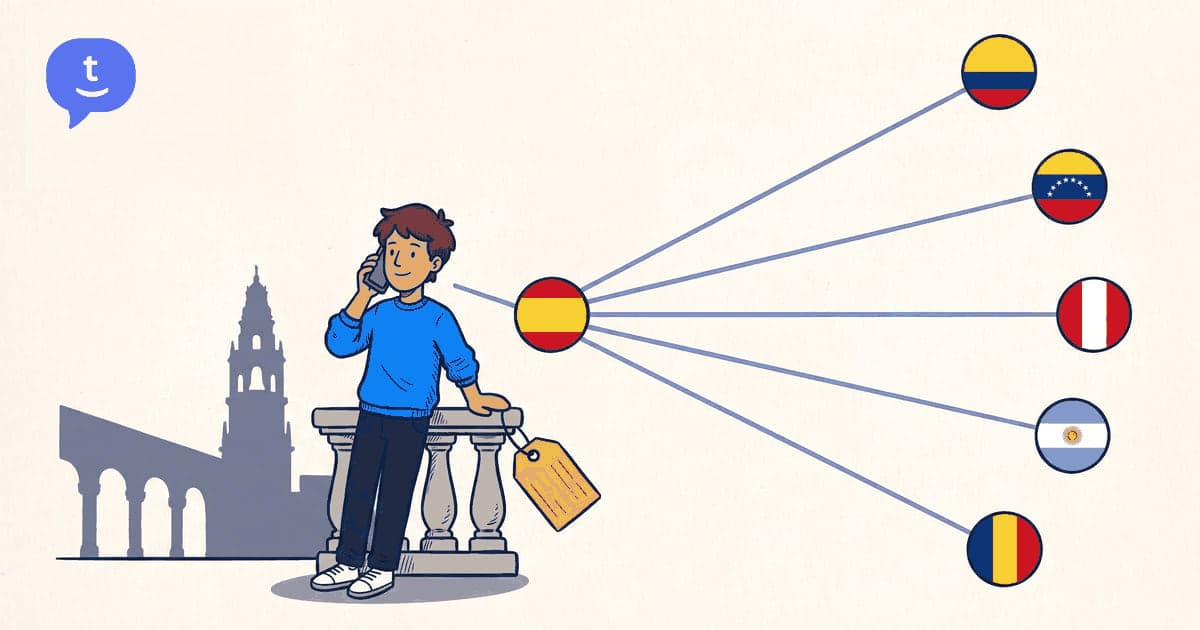
These are the nine destinations people call most from Spain. We quote TwinPhone's per-minute price where our billing data covers the country; for the others, the dialer shows the exact rate before the call connects. Each one has a dedicated route page — Colombia from Spain, Venezuela from Spain, Peru from Spain and so on — with the dialing format, the time difference and the best hours to call; the busiest routes are linked below this article, and every other destination is on the rates page.
Colombia is the biggest corridor: $0.03–$0.06 per minute to mobiles, which is what most Colombians answer on, and $0.11 to landlines, against a typical carrier average around $0.12. For Venezuela, Peru and Argentina, check the rate in the dialer before you call; mobiles and landlines are often priced differently, so it can pay to dial the fixed line when one exists.
For Romania — the largest EU corridor out of Spain — the dialer shows the rate before you call; compare it with the €0.19 plus VAT that the EU cap still allows carriers to charge. The Dominican Republic runs $0.11 per minute to landlines and $0.11 to mobiles.
And now the honest part: some corridors are expensive no matter who carries the call, because termination fees in those countries are high. Ecuador costs $0.41 per minute to landlines and $0.62–$0.72 to mobiles on TwinPhone, and several app-based services charge less to Ecuador, so compare before a long call. Bolivia and Honduras are dear too; the dialer shows their exact rate before connecting. Nobody connects Quito or La Paz for two cents a minute — and you should distrust any service that claims to.
How to Call Abroad from a Browser, Step by Step
Step 1. Open twin-phone.com in Chrome, Edge, Safari or Brave — on a laptop or directly on your phone — and create an account. Signing up is free.
Step 2. Top up your balance. The minimum is $10, pay-as-you-go, with no subscription attached; unused credit simply stays on your account.
Step 3. Dial the number in international format — for Colombia that means +57 followed by the 10-digit number — or pick a saved contact. You can check the exact per-minute rate for any destination on the rates page before you call, so there are no surprises on the bill.
Step 4. Talk. The call travels encrypted (TLS and SRTP) from your browser to the regular phone network, and the other person receives a normal call on their landline or mobile. They need no app, no account and no internet connection.
Step 5. If you call often from your phone, install the site as a PWA from the browser menu. It gets a home-screen icon and opens full screen like a native app — still with nothing to download from an app store.
The Honest Math: Rounding, Minimums and What 'Free' Really Means
A worked example keeps everyone honest. A call of 4 minutes and 10 seconds is billed as 5 minutes, because per-minute billing always rounds partial minutes up — at $0.03–$0.06 per minute to a Colombian mobile, or $0.62–$0.72 per minute to an Ecuadorian mobile, because Ecuador is a genuinely expensive destination. That rounding is the real price of simplicity: a 10-second call costs one full minute. If you make many very short calls, factor it in.
On the word 'free': creating a TwinPhone account costs nothing and there is no monthly fee, but the calls themselves are never free — every call is paid per minute from your balance, at the rate shown before it connects. Anything that touches the real phone network pays termination fees to the operator at the other end, so services advertising truly free unlimited calls to landlines and mobiles are either app-to-app calling in disguise, ad-funded trickles of a few minutes, or simply misleading.
For most people calling from Spain, the practical bottom line is this: use WhatsApp when both sides have it and the connection holds, and a $10 pay-as-you-go top-up — at least 166 minutes to a Colombian mobile — for everything that has to ring on a real number.